
Reliable Local Storage for Medical Edge AI
Reliable Local Storage for Medical Edge AI
Connecting medical data capture with AI processing and recovery
RAIDONTEK Knowledge Center
Medical AI depends on a data workflow that extends beyond inference. Images and sensor records must be captured, selected data retained, software and models loaded, and results made available for review. Reliable local storage supports these connections. RAIDONTEK provides modular NVMe and hardware RAID platforms that OEMs can evaluate for imaging computers, surgical recording systems and connected medical equipment.
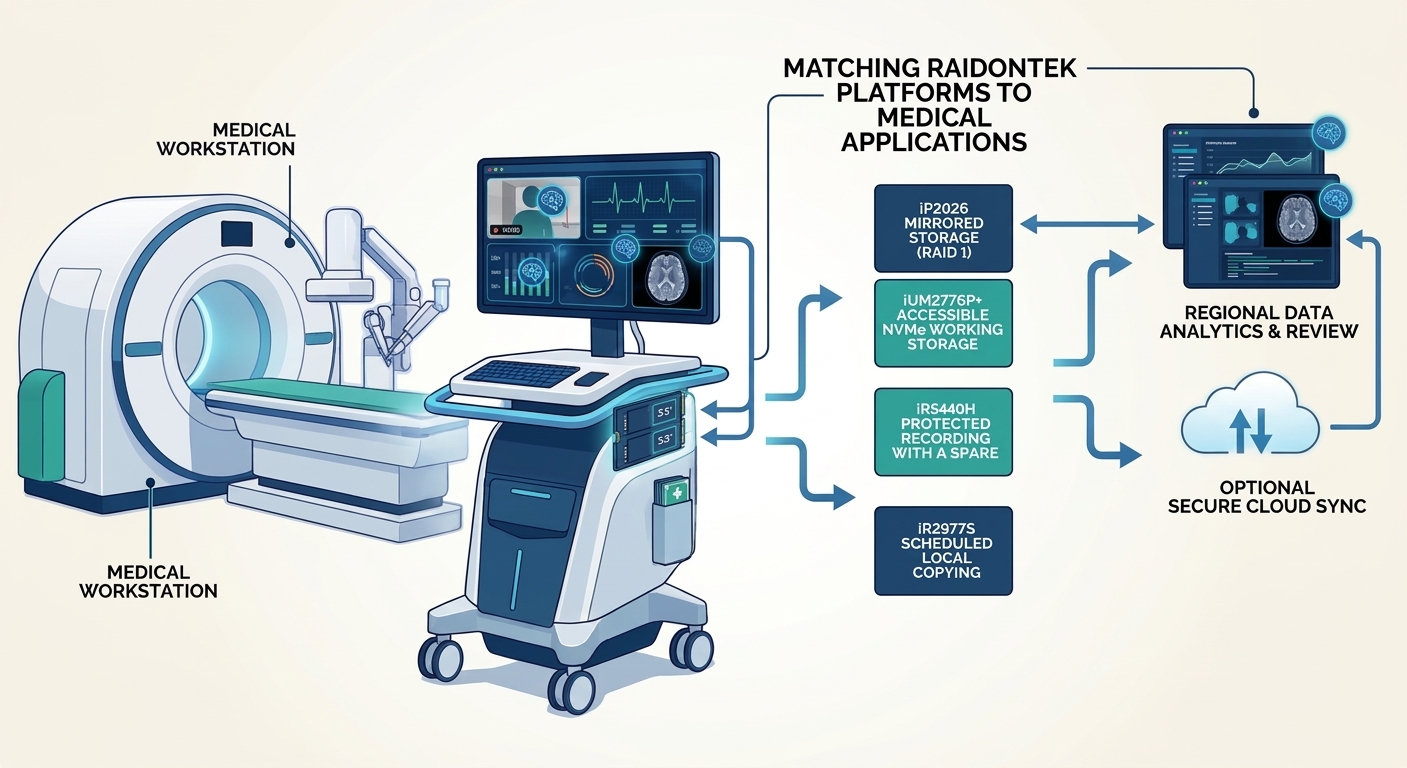
Medical AI brings data processing closer to the equipment
NVIDIA Holoscan illustrates the development of medical edge AI: its platform supports streaming sensor processing, inference and visualization close to the device. Medical imaging and healthcare robotics are among its published applications. [1]
Hybrid workflows also create local data requirements. In Advantech's published Theator implementation, an operating-room computer captures and encodes surgical video, logs metadata and transmits encrypted streams for cloud-based analytics. [2] This example demonstrates the importance of the local acquisition layer even when advanced analysis runs elsewhere.
For equipment designers, the storage question is therefore broader than dataset capacity. A useful architecture must account for concurrent recording and analysis, interruptions to network transfer, drive service and recovery after a software or hardware problem.
Where storage connects the medical AI workflow
The following framework describes potential storage roles in an OEM design. The application software manages data relationships, timestamps and transfer policies; storage modules provide the underlying media access and protection functions.
|
Workflow stage |
Data requirement |
Local storage role |
|
Capture |
Images, video and sensor records |
Retain selected inputs and buffer data awaiting transfer. |
|
Process and infer |
AI models and active datasets |
Load models and supply stored data for analysis or replay. |
|
Record and review |
Outputs, annotations and logs |
Preserve results with the metadata needed for later review. |
|
Transfer and retain |
Records awaiting hospital or cloud storage |
Provide a temporary local copy under the OEM retention policy. |
|
Maintain and recover |
Software, configuration and stored records |
Support drive replacement, backup and a tested restoration process. |
Live sensor streams can flow through memory to the processor. Background recording, backups and RAID rebuilding should preserve processing latency. Dedicated hardware RAID controllers handle supported mirroring and parity operations within the storage subsystem, reducing host-side RAID processing requirements. Sustained recording performance and processing latency should be validated under the intended workload, including degraded operation and rebuilding. Local capacity depends on recorded data and retention requirements.
Matching RAIDON platforms to medical applications
Diagnostic imaging and digital pathology
Imaging workstations can use local SSDs for active image sets, model files and intermediate results. The iUM2776P+ provides two accessible M.2 NVMe drives in a standard 3.5-inch footprint, using a PCIe Gen3 x4 host connection. It exposes independent drives; RAID can be implemented through supported host software or motherboard functions. Hot-plug behavior must be verified on the selected host. [3]
Surgical video and endoscopy recording
Recording systems can retain procedure video with application-generated annotations and event information. The iR5440H combines three-drive RAID 5 with a dedicated hot spare, which starts rebuilding automatically after an active drive fails. Its removable trays simplify drive service. All drives share one SATA III 6 Gb/s host connection, so the recording workload must fit the measured bandwidth during normal and rebuild operation. [4]
This configuration offers a practical option for protected recording and temporary retention. Systems with heavier acquisition requirements can use an NVMe working volume and a separate retention volume, subject to end-to-end validation.
Patient monitoring gateways and medical computers
Central monitoring stations and gateways may need to retain waveform history, event records and transfer queues from multiple devices. The iR2026 supports hardware RAID 1 across two 2.5-inch SATA drives, offering mirrored storage for supported system or data volumes. Its RS232 interface enables OEM integration of drive-status reporting. [5] Drive redundancy can reduce disruption from a single drive failure; overall availability also depends on the host, power and application design.
Connected equipment and laboratory platforms
Equipment software, configuration and local results need a defined recovery procedure. The iR2977S provides scheduled copying and one-touch backup functions that can support this procedure. [6] The OEM should establish when a copy is made, how application consistency is maintained and how restoration is performed. Model or software version tracking remains an application responsibility.
|
Design requirement |
Platform to evaluate |
Primary contribution |
|
Accessible NVMe working storage |
iUM2776P+ |
Independent SSD access and front service. |
|
Mirrored SATA storage |
iR2026 in RAID 1 |
Protection against a single drive failure. |
|
Protected recording with a spare |
iR5440H |
RAID 5 and automatic rebuild initiation. |
|
Scheduled local copying |
iR2977S |
Backup functions for a defined recovery process. |
Designing for availability and recovery
Storage protection should address the failure being managed. RAID protects against supported drive failures. Independent backups preserve recoverable copies when deletion or corruption affects the live data. A hot spare shortens the wait for rebuild initiation, but RAID 5 still tolerates only one active-drive failure before redundancy is restored. [4]
A medical OEM should validate the full workload with a failed drive, rebuilding in progress and background transfers active. SSD endurance, power-loss behavior, temperature, boot behavior and service access should be evaluated on the intended platform. These checks establish whether the proposed storage design meets the equipment's actual operating requirements.
Data protection also includes confidentiality. Access controls, encryption where required, key management and drive-disposal procedures belong in the system design. Local storage alone does not establish privacy compliance, and the finished equipment requires its applicable medical qualification. Storage modules should be specified and validated within that equipment design.
Integrating storage into the OEM platform
RAIDONTEK's role is to help equipment builders select and integrate storage around their requirements for performance, reliability, availability and recovery. Its standard platforms provide starting points for discussion of form factor, interfaces and monitoring, with OEM and ODM development available for requirements that need a different implementation. [7]
The strongest design starts with the data workflow: what must be recorded, what must remain available after a drive failure, and how the equipment will return to service. Connecting these needs to a suitable storage platform gives medical AI developers a clearer basis for integration and validation.
Discuss Your Requirements with RAIDONTEK. Share your data rate, retention period, host interface, chassis constraints and recovery objectives to explore a suitable storage configuration.
References
[1] NVIDIA. Holoscan platform and medical edge AI applications.
[2] Advantech. A Giant Step Forward for the Application of AI in Surgery.
[3] RAIDON. iUM2776P+ product specifications and integration guidance.
[4] RAIDON. iR5440H product specifications and RAID 5 plus hot spare FAQ.
[5] RAIDON. iR2026 product specifications and monitoring interfaces.
[6] RAIDON. iR2977S product specifications and backup functions.
[7] RAIDONTEK. Custom storage solutions and OEM and ODM capabilities.
Sources accessed 14 October 2026. Application mappings describe proposed OEM uses, not documented deployments of RAIDON products in the cited medical systems.
Medical application introduction copy
Storage for Medical Edge AI
AI-enabled medical systems need dependable access to images, recordings, model files and device records. RAIDONTEK offers modular storage platforms that OEMs can evaluate for imaging workstations, surgical recording systems, monitoring gateways and connected medical equipment.
Accessible NVMe modules support active data workflows, while hardware RAID platforms provide drive redundancy and simplify replacement. Scheduled local copying can support a defined recovery procedure. Platform selection starts with the equipment's data rate, retention requirements and service needs, followed by validation on the intended host.
Work with RAIDONTEK to explore a storage design that connects data capture, AI processing and local recovery within your medical computing platform.
Button: Discuss Your Requirements
Diagnostic imaging and AI workstations
Bring active image sets, model files and analysis results close to the workstation. RAIDON NVMe modules offer accessible SSD integration, while mirrored SATA storage can support protected system and application volumes.
Surgical video and endoscopy systems
Support local procedure recording and retention of AI annotations. RAIDON hardware RAID platforms provide drive protection and accessible service, with NVMe options for workloads requiring a faster working volume.
Monitoring gateways and central stations
Preserve locally collected waveform history, event records and transfer queues. Mirrored storage and integrated health reporting can support maintenance planning in monitoring gateways and medical computers.
Connected medical and laboratory equipment
Support local software, configuration and data recovery with a defined copying and restoration process. RAIDON backup platforms provide functions that equipment OEMs can incorporate into their service procedures.
Homepage Knowledge card copy
Reliable Local Storage for Medical Edge AI
Explore how modular NVMe storage, hardware RAID and scheduled local copying can support medical data capture, AI processing and equipment recovery. See potential applications in imaging workstations, surgical recording systems and monitoring gateways.
Button: Read the Article
Website publication fields
Knowledge category: Application
Article title and H1: Reliable Local Storage for Medical Edge AI
Subtitle: Connecting medical data capture with AI processing and recovery
SEO title: Medical Edge AI Storage and RAID Applications | RAIDONTEK
Meta description: Explore RAIDONTEK NVMe and hardware RAID applications for medical edge AI, imaging workstations, surgical recording, monitoring gateways and recovery.
Suggested slug: medical-edge-ai-storage
Suggested topics: medical edge AI storage; medical imaging storage; surgical video recording; OEM hardware RAID; local data recovery
Related product links
iUM2776P+ dual M.2 NVMe module
iR2026 dual-drive hardware RAID module
iR5440H RAID 5 plus hot spare module
iR2977S scheduled backup module
Related Knowledge links
The NVMe Interface: Powering Next-Generation Storage
Utilizing RAID 1 and Scheduled Backups to Mitigate Potential Threats to SSD Storage
Placement and navigation
Feature the article in the homepage Knowledge area and link it from the Medical Systems application introduction. Link the article's product names to their current product pages and its closing CTA to the RAIDONTEK contact page. Use the new article's actual CMS URL for the Read the Article button after the entry is created.